Designed for tight and hard-to-reach sites, these machines offer precise control and strong performance.
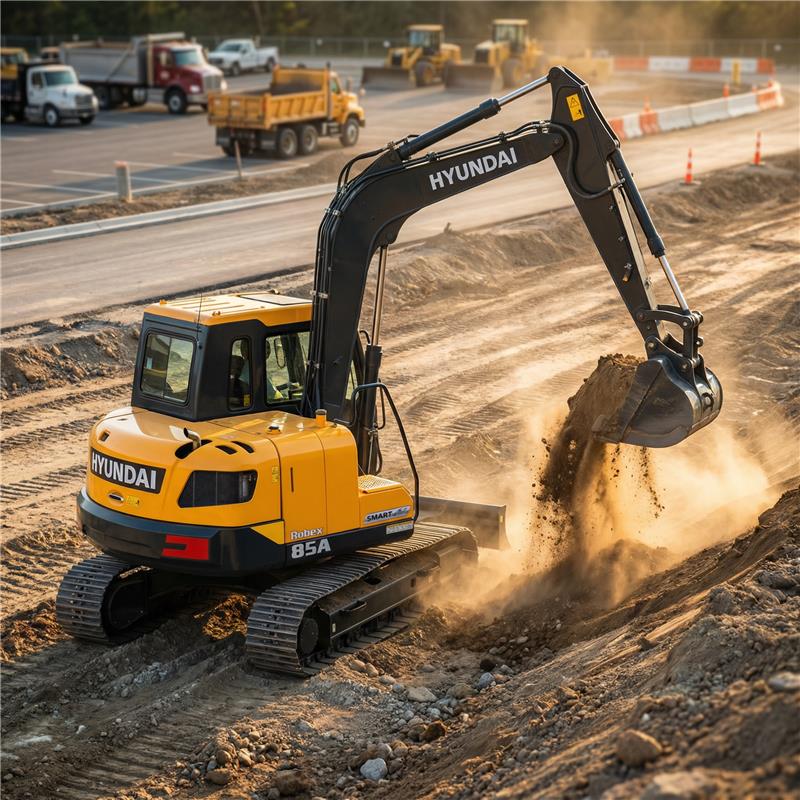
When working in confined spaces on construction sites, you need a machine that fits without compromising digging power. HPE Africa’s versatile Hyundai mini excavators deliver full hydraulic performance, even when space is limited.
The smaller models in this range are perfect for residential construction, utility work, and landscaping—places where you’re working between structures, along property boundaries, or through standard gates.
With zero-tail-swing, the counterweight of the R35Z-9 stays within the track width during a full 360-degree rotation, letting you work safely alongside walls and fences while reducing the risk of property damage and wasted time in tight spaces.
If your work is primarily urban residential — foundations and drainage close to existing structures — the R35Z-9 is the natural fit. Its zero-tail-swing design lets it operate in genuinely confined spaces without the counterweight becoming a problem, and its low ground pressure protects surfaces on sensitive sites. It's also the easiest to transport, which matters when you're moving between jobs regularly.
Step up to the HX60G or R85A when the work demands more — trenching on larger plots, bulk excavation, or loading applications where you need a balance of digging force, fuel efficiency, and daily productivity. These are conventional-swing machines, so they need adequate swing clearance, but in most general construction environments that's not a constraint.
For heavier-duty work — deeper excavations, larger commercial groundworks, or mining support operations — the R150LS provides the reach and bucket capacity to handle that volume. It runs a short-tail-swing configuration rather than full zero-swing, so it's still more manageable on tighter sites than a conventional machine of similar weight.
If your work is primarily urban residential — foundations and drainage close to existing structures — the R35Z-9 is the natural fit. Its zero-tail-swing design lets it operate in genuinely confined spaces without the counterweight becoming a problem, and its low ground pressure protects surfaces on sensitive sites. It's also the easiest to transport, which matters when you're moving between jobs regularly.
Step up to the HX60G or R85A when the work demands more — trenching on larger plots, bulk excavation, or loading applications where you need a balance of digging force, fuel efficiency, and daily productivity. These are conventional-swing machines, so they need adequate swing clearance, but in most general construction environments that's not a constraint.
For heavier-duty work — deeper excavations, larger commercial groundworks, or mining support operations — the R150LS provides the reach and bucket capacity to handle that volume. It runs a short-tail-swing configuration rather than full zero-swing, so it's still more manageable on tighter sites than a conventional machine of similar weight.
The track configuration you choose determines what surfaces you can work on, how much damage you leave behind, and how long the undercarriage lasts.
Rubber tracks are the right choice for finished surfaces — paving, concrete, landscaped areas — where steel would cause damage. They also run quieter on urban residential sites. The trade-off is wear life: rubber degrades faster on sharp rock, abrasive gravel, or hard-pack ground, so if that's your regular environment, replacement costs add up.
Steel tracks handle the punishment rubber can't. On rocky ground, hard clay, or demolition sites with debris underfoot, steel lasts longer and gives you better traction. The limitation is surface damage, which rules them out wherever the surroundings need to stay intact.
We hold parts inventory for the complete Hyundai mini excavator range. These machines require regular attention — hydraulic system servicing, undercarriage inspections, and engine maintenance — and the right schedule depends on how hard you’re running the equipment and the type of ground you’re working on.
They are designed for straightforward servicing. Engine compartments provide ground-level access to filters and key service points, making daily checks quick and easy. It’s a practical design that reduces the small delays that can add up over a busy week.


